
fsl constructs
biosurface engineering in a bottle
Kode Technology is an easy, fast, versatile and controllable technology for temporary modification of any cell, virus, organism or surface, designed to change the way biological surfaces interact.
What FSL constructs are: three parts
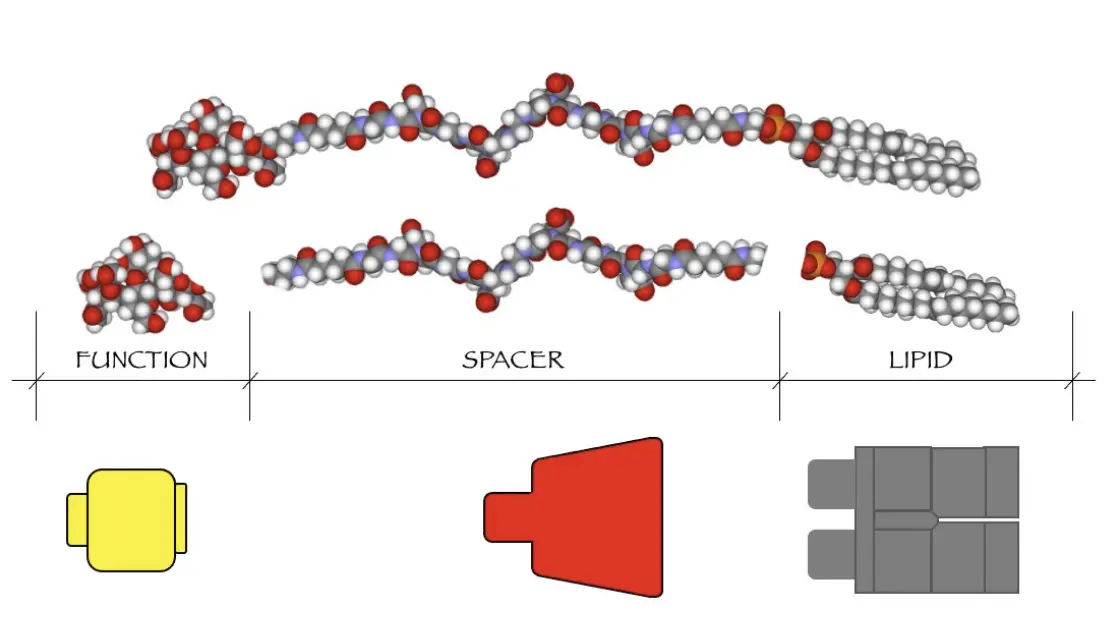
Function-Spacer-Lipid (FSL) constructs attach almost any small molecule to any surface. Each is amphipathic: a water-loving functional head and spacer, and a water-hating lipid tail.

The functional head: a glycan, peptide, label or other molecule
The spacer: links the head to the lipid and presents it away from the surface
The lipid tail: anchors the construct into the membrane or surface
Shelf-stable: simple glycan constructs keep for months at room temperature, and most are stable for more than 10 years when stored appropriately. Kode Biotech has designed, made and sold FSL constructs for more than 20 years.
FSL architecture: FSL spacer-lipids enable multiple formats of a single function
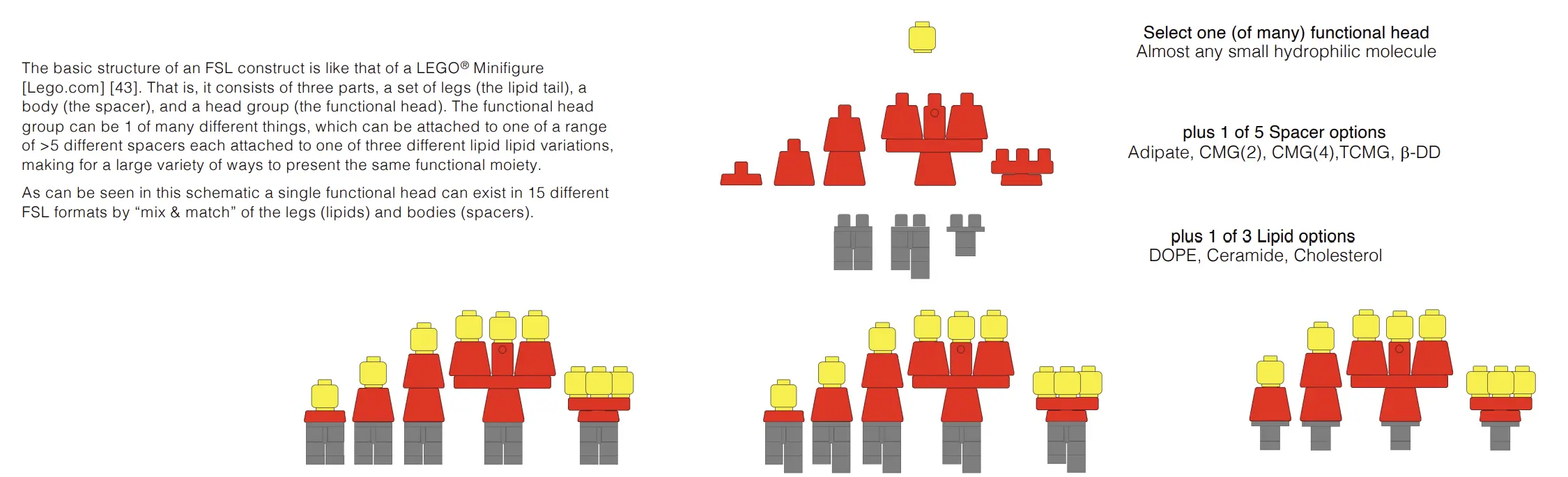
By changing the spacer and lipid components, the same functional head can be presented in different configurations.
These variations influence how far the functional head extends from the surface, its visibility and accessibility, and its ability to interact with other molecules.
This ability to tailor the presentation of a single function is one of the key features of Kode Technology.
Different ways to present a functional head
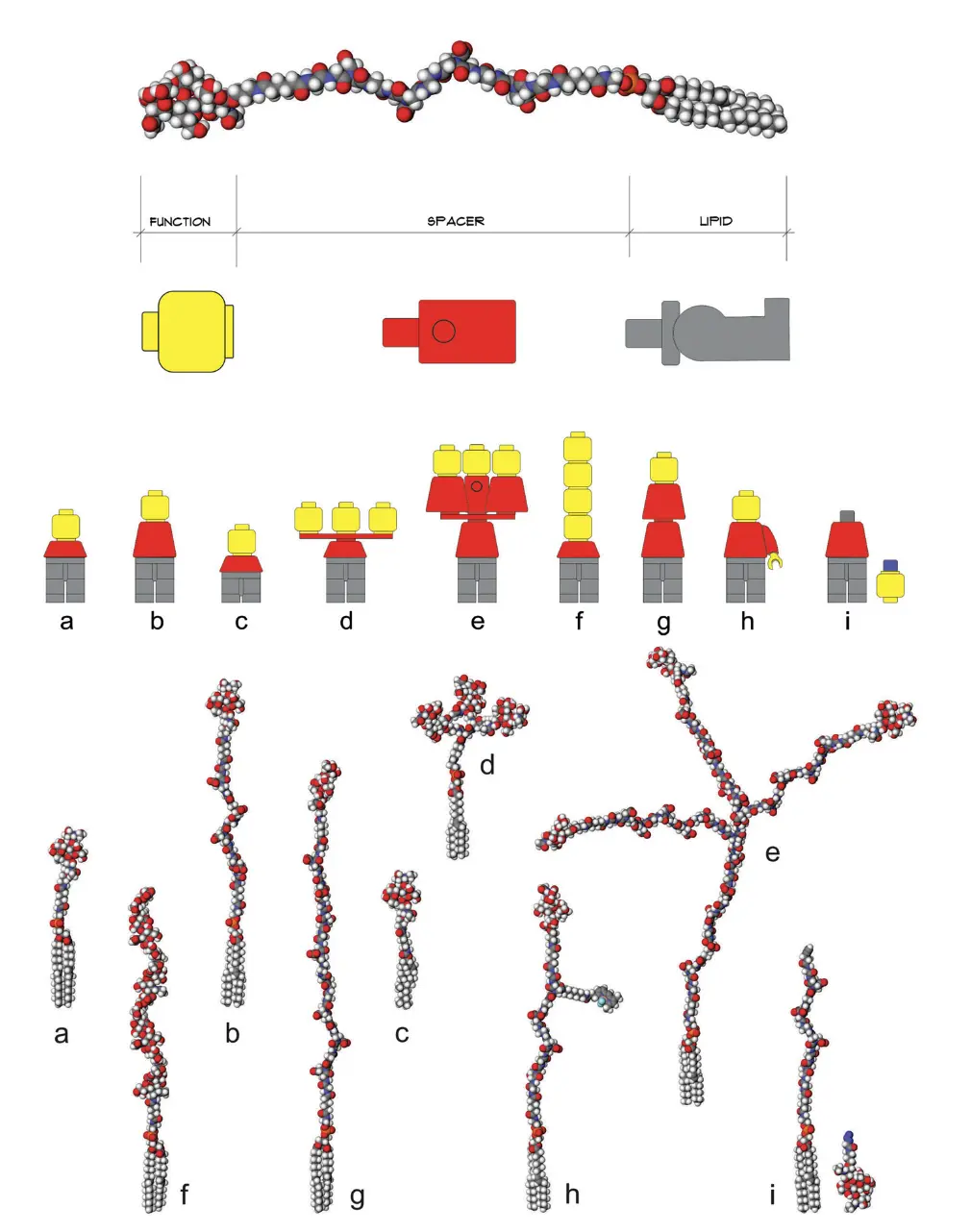
The upper image shows a generic Kode construct: a carboxymethylglycine (CMG) spacer linked to a DOPE lipid tail. In the building-block figures beneath, the yellow head is the functional head, the red body is the spacer and the grey legs are the lipid tail.
The nine structures at the bottom are space-filling molecular models of those figures. Each carries the same blood group A tetrasaccharide head, except (f), which has an 8-mer hyaluronic acid head.
- (a) short 1 nm adipate spacer
- (b) 7 nm CMG spacer
- (c) sterol lipid instead of DOPE
- (d) clustered heads
- (e) branched spacer, trimeric heads
- (f) linear repeating functional heads
- (g) double CMG spacer
- (h) functionalised CMG spacer carrying a second function (here the fluorophore BODIPY)
- (i) functional head attached afterwards, here by click chemistry
Figure from Henry SM, Bovin NV. Kode Technology: a universal cell surface glycan modification technology. Journal of the Royal Society of New Zealand 2019; 49(2):100–113. Copyright Kode Biotech.
How FSL constructs work: paint, not genetics
FSL constructs self-assemble and coat or insert into surfaces within minutes, without genetic modification or chemical conjugation. The coating lasts days in living systems.
From the University of Auckland, or download from the National Library of NZ.
Kode Technology: biosurface engineering with FSL constructs (1 min 45 s).
Founded in New Zealand to develop, commercialise and license Kode Technology
Designing, making and selling FSL constructs
FSL research probes, including glycans, peptides, labels and much more
Distribution through GlycoNZ and Merck MilliporeSigma
Kodecytes and kodevirions: koded cells and viruses
Kodecytes
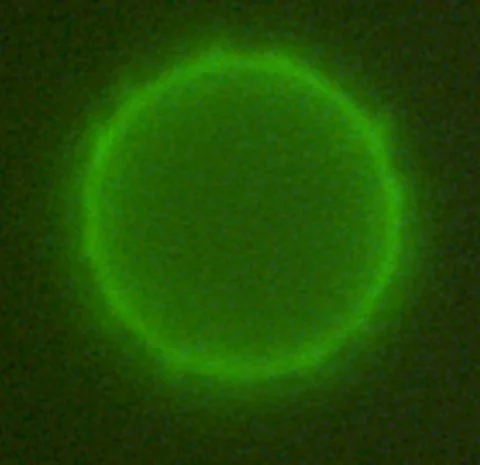
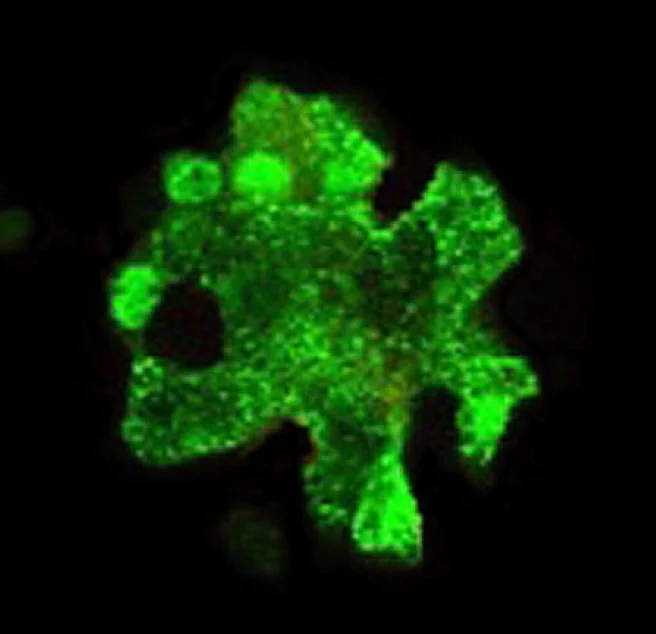
"A kodecyte is simply defined as any living or dead cell which has detectable FSL constructs on its surface." Almost any cell can be labelled: red and white blood cells, platelets, cell lines, tissue cells and bacteria.
Kodevirions
Viruses modified with FSL constructs, named in the same way as kodecytes. Used in virological research.
FSL construct applications: where they are used
Therapeutics
- Kode Immunoeducers (KIEs), investigational
- Liposome modification
- Other Kode-enabled potential therapeutics
Diagnostics
- Detection of diagnostically significant antibodies
- Antibody mapping and quantitation
Research
- Fluorescent live cells and viruses
- Cell tethering
- Virological research (kodevirions)
- Microbial interactions
- Lectin studies
QA and teaching
- Serologic mimics
- Quality assurance systems
- Teaching systems
Modified biosurfaces also have potential uses in tissue engineering, transplantation, drug targeting and release, biosensors, bioelectronics and consumer products.
Custom FSL constructs: made to order
Essentially any small molecule that needs to be attached to a cell, virus, liposome or non-biological surface can be made into an FSL construct.
Buy research FSL constructs from GlycoNZ
FSL constructs for research are sold by GlycoNZ (glyconz.com) and Merck MilliporeSigma.
Buy research FSLsFSL constructs: frequently asked questions
What are the key scientific papers on Kode Technology?
The key publications are highlighted in red in the Science and Publications section.
What are FSL (Function-Spacer-Lipid) constructs?
Amphipathic, self-assembling molecules that attach almost any small molecule to any surface by non-covalent interaction. Each has a functional head, a spacer and a lipid tail.
What do the function, spacer and lipid parts do?
The function is the molecule being presented, such as a glycan, peptide or label. The spacer links and presents it. The lipid anchors the construct into or onto the surface.
How do FSL constructs modify cell and virus surfaces?
When cells or viruses are in contact with an FSL solution, the constructs spontaneously insert their lipid tails into the membrane, usually with no impact on vitality and function.
How stable are FSL constructs?
On living cells the labelling is temporary, lasting days. Simple glycan constructs are highly shelf-stable, most for more than 10 years when stored appropriately; more complex constructs may be less so.
What are kodecytes and kodevirions used for?
Research, diagnostics, quality assurance and teaching: for example detecting and mapping antibodies, serologic mimics, fluorescent labelling and virological research.
Can Kode Biotech design custom FSL constructs?
Yes. Essentially any small molecule can be made into an FSL construct. Use the custom FSL enquiry form.
Where can I buy FSL constructs?
From GlycoNZ (glyconz.com) and Merck MilliporeSigma.
Further reading: the science
Kode Technology Illustrated Technical Manual
Kode Biotech, first edition 2023. ISBN 978-1-9911998-0-5. From the University of Auckland and the National Library of NZ.
University of AucklandNational Library of NZDownloads
DSc thesis: Kode Technology (2025, ISBN 978-1-9911998-1-2)
Full Kode Technology bibliography and subject index
all downloadsJoVE video article
Blake DA, Bovin NV, Bess D, Henry SM (2011). FSL constructs: a simple method for modifying cell and virion surfaces with a range of biological markers without affecting their viability. Journal of Visualized Experiments (54): e3289.
watch on jove.comScience and Publications
The key publications are highlighted in red in the Science and Publications section.
all publicationsWork with us: custom constructs and licensing
Commission a custom FSL construct, license Kode Technology for a new application, or extend your research with R&D constructs from our catalogue.