
About Kode Immunoeducers: a distinct approach
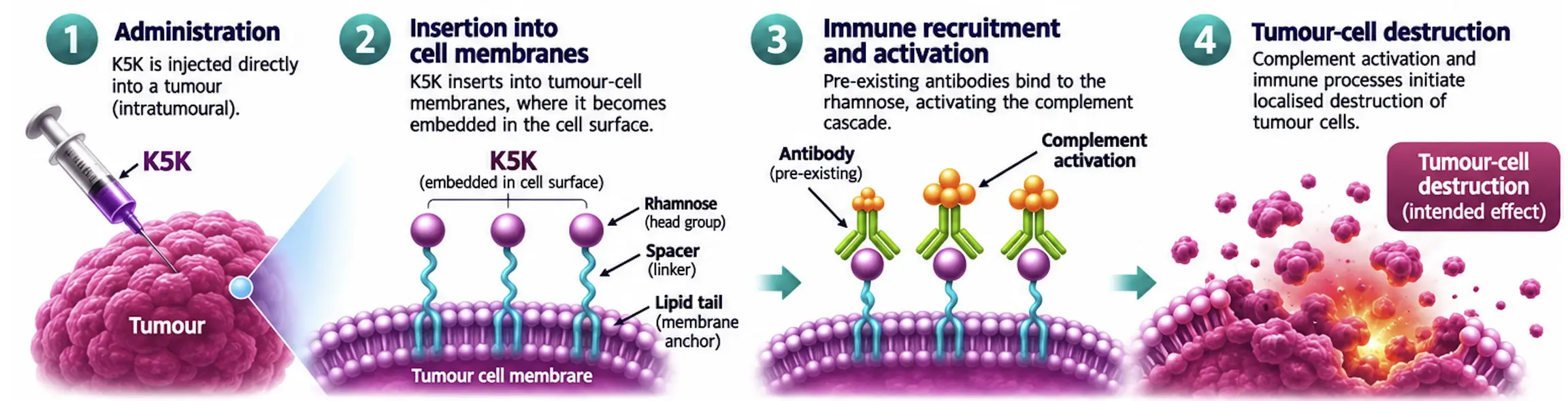
Kode Immuno-Educers (KIEs) represent a distinct approach to cancer immunotherapy, combining a novel initiating mechanism with established immunological processes to achieve their intended therapeutic effects. KIEs introduce foreign immune-reactive markers (such as the rhamnose epitope presented by K5K) onto tumour-cell membranes, with the aim of recruiting pre-existing antibodies and activating complement.
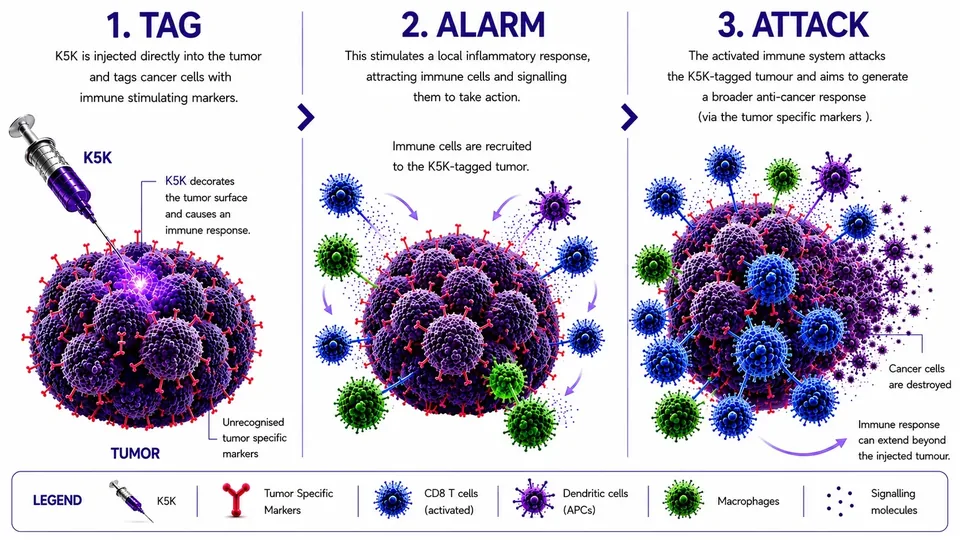
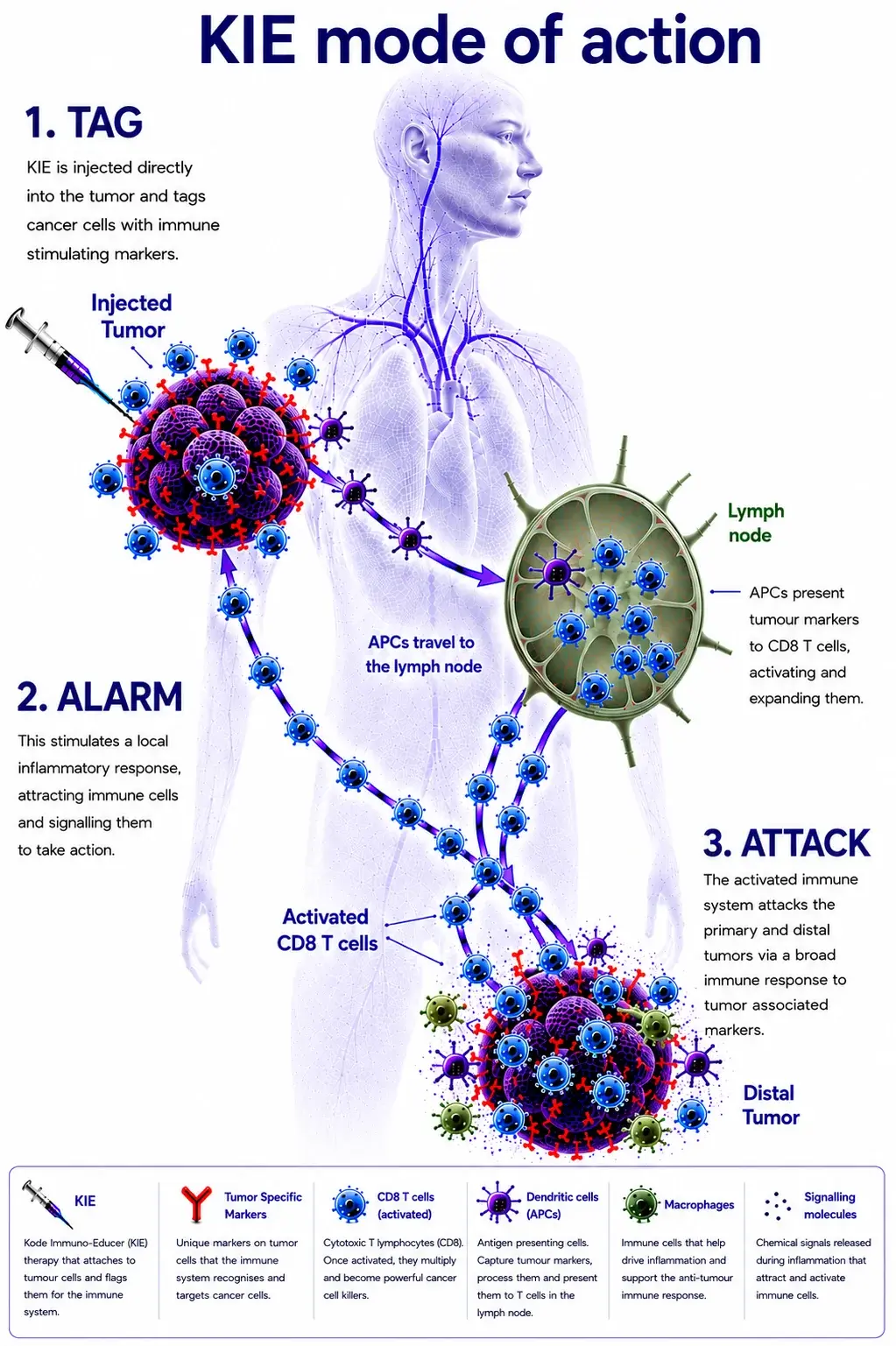
This is designed to initiate an adjuvant-like immune response and promote the treated tumour as the antigen source for an in situ autologous cancer vaccine. By engaging immune mechanisms also exploited by other therapeutic technologies, KIEs have the potential to act independently and to enhance the effects of other cancer treatments when used in combination.
Kode Biotech Limited owns Kode Technology and licenses it to KodeRx, Kode Agalimmune and Kode Veterinary Sciences.
How a KIE works: the tumour becomes the vaccine
Some vaccines combine a target antigen with an immune-stimulating adjuvant. With KIEs, the patient's tumour provides the antigen source, while the injected KIE supplies an immune-initiating signal.
KIEs compared with a vaccine: same principles, new approach
| Element | Conventional adjuvanted vaccine | KIE approach |
|---|---|---|
| A — immune activation | An adjuvant included in the vaccine formulation, where required. | An injected KIE: a membrane-inserting, antibody-recruiting, complement-activating construct with adjuvant-like activity. |
| B — target antigen | Defined antigens must be identified and are supplied in the product. | Tumour-associated antigens and any patient-specific neoantigens already present in the tumour; their identity need not be known. |
| Where A meets B | Both components are usually delivered together as a formulated vaccine. | The KIE construct acts locally in a tumour; injury, antigen release, immune uptake and presentation are intended to occur in situ. |
| Desired result | An adaptive immune response to the supplied antigen. | An adaptive response to the patient's own tumour antigens, potentially extending beyond the injected lesion. |
Not all vaccines contain added adjuvants.
What is distinctive about KIEs: four differences
No predefined antigen payload
The approach does not require identifying and manufacturing a personalised tumour-antigen vaccine for each patient; the tumour itself provides the antigens.
Pre-existing antibodies
The displayed glycan is intended to recruit antibodies already present in the patient, rather than relying solely on generating a new immune response to the drug construct.
The complement system
Complement is one of the most potent components of the innate immune system, contributing to targeted cell destruction, opsonisation, immune-cell recruitment and activation, as well as a range of other immunological functions, including tissue repair and regeneration.
Local start, broader ambition
An accessible tumour lesion provides the starting point for immune activation and systemic anti-tumour immunity.
KIE generations: from natural glycolipids to
Gen 3 KIEs
Each generation of Kode Immunoeducer has improved the same idea: put a marker on the tumour for which naturally occurring antibodies already exist.
Natural α-Gal glycolipids
Dr Uri Galili showed that α-Gal glycolipids injected into tumours could turn them into targets for the antibodies people already carry.
In 2014 he found that FSL-Galili, Kode Biotech's synthetic version, outperformed the natural glycolipid he was using.
AGI-134
A fully synthetic α-Gal KIE, designed to recruit the anti-Gal antibodies people already have and to activate complement.
AGI-134 progressed to a Phase 1/2a human clinical study, with positive clinical findings providing important human experience with the KIE approach. In 38 late-stage, heavily pre-treated patients it met its safety endpoint with no dose-limiting toxicity, and 29% had stable disease, seven of whom had already failed checkpoint-inhibitor immunotherapy.
K5K and Kv9
K5K and Kv9 are Gen 3 KIE molecules, identical by structure. They present rhamnose on a redesigned construct, intended to improve on the Gen 2 KIEs. Details will be published in due course.
Gen 2 and Gen 3 compared
| AGI-134 · Gen 2 | K5K and Kv9 · Gen 3 | |
|---|---|---|
| Marker displayed | α-Gal trisaccharide | α-Rhamnose monosaccharide |
| Antibodies recruited | Naturally occurring anti-Gal antibodies | Naturally occurring anti-rhamnose antibodies |
| Complement activation | Yes (++) | Yes (++++) |
| Shared aim | The tumour becomes the vaccine. An in situ autologous cancer vaccine: the patient's own tumour supplies the antigens | |
| Stage | Phase 1/2a safety and dose-finding study completed in 38 late-stage human patients | Kv9 in veterinary pilot trials in New Zealand. K5K is preparing for first-in-human trials |
K5K design characteristics: built to reach more patients
K5K is designed from the start to be affordable and practical to deliver, including in health systems with limited resources.
Affordable by design
A target treatment cost of less than US$5,000 per course.
Stable above 40°C
Reducing reliance on refrigeration and cold-chain infrastructure.
Scalable manufacturing
A novel, fully synthetic construct, made by chemical synthesis.
Beyond specialist centres
Potential delivery outside major specialist centres, where clinically appropriate.
How Kode Immunoeducers could be given: the three key routes
Into the tumour
Injected directly into an accessible tumour, or guided by ultrasound or other imaging for deeper tumours.
During surgery
Injected into the tumour or the tumour bed during an operation, without an extra visit.
Outside the body
Tumour cells from a biopsy or surgery, or isolated from blood, can also be modified in the laboratory, as Kode Technology routinely does with cells, and could then be returned to the patient as a vaccine.
Kode Immunoeducers alone or in combination: ideal for combination therapies
As a monotherapy or in combination with other cancer treatments
KIEs have the potential to act independently and to enhance the effects of other cancer treatments when used in combination.
In its first human study, AGI-134, the Gen 2 KIE, met its safety endpoint in 38 late-stage, heavily pre-treated patients. Eleven (29%) had stable disease, seven of them after checkpoint immunotherapy had stopped working, and immune cells entered both injected and uninjected tumours. Side effects were mostly mild to moderate and short-lived; the most common were tiredness and pain at the injection site. Gen 3 KIEs, K5K and Kv9, are designed to build on AGI-134.
KIEs probably best suit earlier-stage disease. The number of doses needed has not yet been determined.
KIE programmes: three programmes

AGI-134
Evidence: Mechanistic preclinical publication (Shaw et al. 2019); Phase 1/2a safety and dose-finding study completed in 38 late-stage human patients, with stable disease in 29%.

Kv9
Evidence: Preliminary canine experience provides translational evidence.

K5K
Evidence: Strong laboratory data.
Investigational human-development candidate; safety and efficacy have not yet been established in humans.
Blood cancers
Direction: KIEs may also work in blood cancers: leukaemic cells are treated in the laboratory and returned as a vaccine.
K5K and Kv9 are Gen 3 KIE molecules, identical by structure.
Blood cancers are a future direction, not yet a programme.
Kv9: what dogs can tell us
Kv9 is an experimental Gen 3 KIE licensed to Kode Veterinary Sciences, and is being evaluated in veterinary oncology across multiple solid tumour types, with preliminary anti-tumour responses observed.
Why dogs are a good model for humans
Pet dogs develop cancers naturally, as people do. The US National Cancer Institute lists the advantages: similar body size, a shared home environment, an intact immune system, tumours that grow naturally with their surrounding tissue, and the same kinds of treatment as people. An intact immune system matters most for an immunotherapy.
NCI Comparative Oncology ProgramTumour types in the New Zealand veterinary pilot study
- Soft tissue sarcomas
- Mast cell tumours
- Mammary gland tumours
- Melanomas
- Anal gland tumours
- Squamous cell carcinomas
- Other tumours may be considered
What the trials are assessing
The safety and efficacy of Kv9 across a range of solid tumours, in pet dogs, cats and horses treated under veterinary supervision. Preliminary canine experience provides translational evidence.
Kv9 is experimental and has not been approved by any regulator.
The veterinary pilot trials run under veterinary supervision; taking part is voluntary and does not guarantee any outcome.
K5K development path: six steps, in order
K5K builds on more than three decades of scientific research and clinical and translational experience with Kode Immunoeducers. It is preparing to progress to first-in-human clinical trials once funding is secured; the next stage is establishing its safety, tolerability and biological activity in people with cancer.
K5K's development path
- PreclinicalLaboratory and animal evidence of safety and potential efficacy, including toxicology
- Trial approvalIs it safe enough to test in people? (Regulator and ethics approval)
- Phase 0First in human: a very small dose in a few patients, to check how it behaves in the body
- Phase 1/2aIs the dosing regime safe, and are there signs of anti-tumour activity?
- Phase 2bDoes it control tumours, including ones not injected, in a chosen cancer type?
- Phase 3Does a randomised trial against standard care confirm the benefit?
KIE commercialisation partners
KIE partnerships go through the Kode Group companies that own each programme: KodeRx and Kode Agalimmune for human cancer, and Kode Veterinary Sciences for veterinary cancer.



Equitable Oncology, an independently governed NZ charity (CC64930), coordinates the clinical, scientific and philanthropic partnerships to advance K5K and AGI-134.
Partner with Equitable Oncology ↗
Kode Immunoeducers: frequently asked questions
What is a Kode Immunoeducer (KIE)?
A membrane-inserting, antibody-recruiting, complement-activating construct with adjuvant-like activity, designed to use the patient's own tumour as the antigen source for in situ vaccination.
How is a KIE different from a personalised cancer vaccine?
A personalised vaccine needs the patient's tumour antigens to be identified and manufactured. With a KIE, the tumour itself provides the antigens, which need not be identified in advance.
What does "in situ autologous cancer vaccine" mean?
The vaccine effect is intended to happen inside the patient's own tumour (in situ), using the patient's own tumour antigens (autologous), rather than antigens supplied in a vial.
What role do pre-existing antibodies and complement play?
The marker a KIE displays is intended to recruit antibodies the patient already has and to activate complement, which may promote local tumour injury, inflammatory signalling and uptake of tumour material by antigen-presenting cells.
What are AGI-134, K5K and Kv9, and what stage is each at?
AGI-134 is a Gen 2 KIE that has completed a Phase 1/2a safety and dose-finding study in 38 late-stage human patients, with stable disease in 29% of them. K5K is an investigational Gen 3 KIE in human development. Kv9, also a Gen 3 KIE, is in veterinary development; preliminary canine experience is translational evidence only. All are investigational.
Why are there generations of KIEs?
Each generation refines the design. AGI-134 (Gen 2 KIE) presents α-Gal and relies on the antibodies a patient already has. K5K and Kv9 (Gen 3 KIEs) present rhamnose on a redesigned construct, intended to improve on the Gen 2 KIEs. Details will be published in due course.
Work with us: partner on Kode Immunoeducers
Licensing and commercial partnerships in human cancer go through KodeRx or Kode Agalimmune; veterinary cancer through Kode Veterinary Sciences. Partner with Equitable Oncology to help bring these investigational therapies to patients and make them accessible worldwide. Everything else starts with Kode Biotech.